SportKompas is a sports orientation and fitness monitoring tool developed in Flanders (Belgium). Based on a physical fitness test battery and an interactive questionnaire, children receive a personalised sports orientation report. In this way, apart from assessing the physical fitness of the children, SportKompas also guides children toward enjoyable and sustainable sport participation. Under the coordination of Sport Vlaanderen, more than 50.000 children have been tested since the program was launched in 2018.
SportKompas
SportKompas is a sports orientation and fitness monitoring tool developed in Flanders (Belgium). Based on a physical fitness test battery and an interactive questionnaire, children receive a personalised sports orientation report. In this way, apart from assessing the physical fitness of the children, SportKompas also guides children toward enjoyable and sustainable sport participation. Under the coordination of Sport Vlaanderen, more than 50.000 children have been tested since the program was launched in 2018.
Background
SportKompas has its origin in talent identification research at Ghent University, where researchers investigated how the profiles of multiple elite athletes showed differences and similarities to one another. However, instead of using these profiles only for talent identification, the researchers realised that they could also be used for sports orientation. Simplified, if basketball coaches indicate that eye-hand coordination, agility, teamwork and physical contact are important aspects of their sport, a child who likes these kinds of aspects will likely enjoy playing basketball more than for example gymnastics.
The Flemish government then provided funding to SportaMundi and Hylyght to turn this concept into a practical product for schools and municipalities. Statistics from Flanders showed that sports participation peaks around the age of 9 and then gradually decreases (Source). With the two primary reasons for quitting a sport being “lack of perceived competence” and “lack of enjoyment” (Crane and Temple, 2015), it was decided that SportKompas should be aimed at 8-9 year olds, and provide sports orientation based on both competence and personal interests. Therefore, SportKompas consists of two modules: I LIKE and I DO. In the I LIKE module, children fill in an interactive questionnaire assessing what kind of activities they like or dislike, while the I DO module consists of a test battery of 9 (or 14) tests for physical fitness and motor competence.
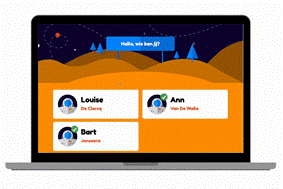

Figures: The I LIKE module (left) and the I DO module (right)
Sports Orientation
Currently, most children enrol in a sport of their parents’ choosing or they get into it through friends. Unfortunately, for many children this leads to a mismatch between their interests and the sport. SportKompas therefore offers an objective method for sport orientation for children aged 6-12. By assessing the interests (I LIKE module) and the physical capabilities of the child (I DO module), SportKompas generates individual reports showing 7 sports that match the child’s interests and capabilities best. When coupled to a local database, children and parents can immediately check whether these sports are offered by a club in their neighbourhood. This way, the child is more likely to try out a sport that otherwise might not have been on the radar. By orienting children to sports that match their profile, SportKompas aims to reduce drop-out of organised sports, and contribute to a lifelong active lifestyle.

Figure: Sports orientation report for the I LIKE and the I DO module
Monitoring physical fitness
The I DO module of SportKompas is not only useful for sports orientation of young children, but also serves as an ideal tool to monitor the development of physical and motor skills of children and adolescents from 6 to 16 years. By comparing the personal development to benchmarks specific to the age and sex, the child and/or teachers can evaluate their physical fitness level to the (inter)national norms. This information can be used by physical education teachers in their classes, but also provides actionable data for governments about the secular trend of fitness, and regional disparities that might need attention.

SportKompas 2.0
During the summer of 2025, an updated version of SportKompas was launched. The main aim of this new version was to reduce the time it takes to carry out the I DO module to under 50 minutes (a standard school ‘hour’ in Flanders). SportKompas was also made more modular so it can now be implemented partially or adapted to local needs. Furthermore, benchmarks were updated (now calculated per month instead of per year), and some improvements to the report towards parents were made.
International partners have already implemented SportKompas in Spain, Finland, Italy, Greece, Poland, and Malaysia. Want to learn more about SportKompas, or start using it in your region? Visit https://sportkompas.com/en
References:
Crane, J., & Temple, V. (2015). A systematic review of dropout from organized sport among children and youth. European physical education review, 21(1), 114-131.
Links:
https://sportkompas.com/en
https://www.sport.vlaanderen
https://hylyght.com/